
Challenge
Deliverables
Role
Find an effective and long-term way to change people's behaviours of disposing of single-use coffee cup waste.
app & product
UX designer
Recycle Rainbow is a product combined with an app that uses gamification to guide people to recycle single-use coffee cups.
Problem Statement
The Environmental Audit Committee reported that coffee cups in the UK’s landfill sites produce an annual carbon footprint equivalent to over 152,000 tonnes of carbon dioxide. Fewer than 1 in 400 of these coffee cups are being recycled because of the logistical difficulties involved in processing coffee cups separately from other recyclable waste. It is urgent to change people's behaviours that how they dispose of coffee cups.
Research
Coffee cups that end up in the UK’s landfill sites produce an annual carbon footprint equivalent to over 152,000 tonnes of carbon dioxide, similar to what 33,300 cars produce in a year. (UK’s House of Commons Environmental Audit Committee, 2017) Even if a disposable cup is placed in paper recycling it is unlikely to be recycled due to the logistical difficulties involved in processing coffee cups separately from other recyclable waste. Fewer than 1 in 400 are being recycled. When coffee cups are thrown into the recycle bin with their lids attached, the components have to be separated before they can be processed in separate recycling streams.
A research report provided an overview of the findings and insights drawn from user-centered research into the use and disposal of single-use coffee cups on the Loughborough University campus and Loughborough in London campus.The findings have been drawn out of user-centered research studies carried out by Loughborough master students between 2017 and 2020. Students used observational techniques (including fly on the wall, participant observation and shadowing) coupled with semi-structured interviews and auto-ethnography.

Findings and Insights

Insights
-
Unclear instructions for disposal: Location, labelling and proximity of the paper and plastic bins reduces the potential for correct disposal and recycling of cups.
-
Lack of correct knowledge of recycling: Incorrect assumptions about if, and how, paper cups can be recycled leads to low collection rates and inappropriate disposal behaviour.
-
Fullness of cup recycling bins: The fullness of cup recycling bins can be off-putting due to hygiene and contamination concerns. This leads to cups being deposited in other bins (paper, plastic, general waste) which contaminates other waste streams and reduces the volume of cups collected and effectively recycled.
-
Other items left in cups: Other waste items are often placed inside cups before they are deposited in the cup bins which results in contamination a barrier to recyclability –and inefficient stacking which reduces the bin capacity and yield. This increases cost for collection and recycling.
-
Influenced by previous incorrect disposal: Previous actions by others influence user behaviour, perpetuating and legitimatising incorrect disposal through ‘herd mentality’. This leads to contamination of waste streams and low collection rates.

Opportunity
How Might We
Turn the above insights into opportunities by using how might we (HMW). This is an effective way to brainstorm solutions. After listing all the HMWs, then I selected the best HMWs.
The following HMWs are in the sweet spot:
1) How might we make students think disposal cups in the right way is fun?
2) How might we enable students to actively follow the right way to dispose of cups that can make the recycle easier?
3) How might we have enough room for recycling bins for disposal cups?
4) How might we design an effective way to collect cups?


Ideation
Crazy Eight
Draw 8 concepts on paper in a limited time based on HMWs.
1) Balance beam: encourage students to make the balance beam stable. Students need to take other items out of the cups and put the cups upside down into the transparent tubes. There is a sharp point at the bottom of the tubes, which encourages students to put the cups upside down.
2) Rainbow: encourages students to match the cups and tubes based on the same colours. After putting the red cup into the red tubes, the red in the rainbow gets closer to the middle of the screen. When all the tubes are full, the rainbow is completed.
3) Trample: provide a place for students to release stress. Students can trample the disposal cups, which also can save the room of cup recycling bins.
4) Compress: put the cups on the conveyor belt and the machine will automatically compress the cups.
5) Race: Lay the cups in one of the tubes. The more cups in certain tubes, the team would get closer to the destination. After each disposal, the app would record points. If the students’ team wins, they will get extra points in the app.
6) Music: when putting cups in different notes, it would play different music.
7) Puzzle: put cups in certain places to complete the puzzle.
8) Put the cups in the ‘snake’ tubes.

Evaluation of ideation
Ask oneself 4 questions to identify whether they meet the requirements.
1) Excite: would my idea excite them?
2) Surprise: what can surprise them?
3) Amuse: what would they find funny, amusing and enjoyable?
4) Satisfy: what is the safe solution?
After listing these features, idea 1 (balance beam), idea 2 (rainbow), idea 5 (race) meet the requirements more possibly.
Forced association: Designers can make connections between different ideas.
Ask myself:
‘What if I combine the app (idea 5) and rainbow?’
‘What if I combine bins of other items (idea 1) and rainbow?’

Initial concept
Students are encouraged to match the cups and tubes based on same colours. They need to take away other items form the cups and put the cups upside down into the tubes. After putting the red cup into the red tubes, red in rainbow get closer to the middle on the screen behind. When all the tubes are full, the rainbow is completed. After each disposal, users can get points or other rewards in the apps. Different players have competition.


Behaviour change strategy
There are 3 key strategies for behaviour change (Lilley 2009):
1) Feedback: Tell users information about their behaviour consequences through different kinds of signs (visual, hearing, touch).
2) Behaviour steering: Design certain ways to encourage users to behave in a certain way.
3) Persuasive technology: Use compulsive ways to change users’ thoughts and actions sometimes without permission.
and gamification is always used with the above strategies. Gamification is to apply game mechanics (points, taking turns, level up, rewards, challenges) in non-game applications to encourage engagement, using the psychology of design (curiosity, competition..)

Selection and combination of strategies
There are 7 key points:
1. Make resources and waste visible
2. Provide feedback in real-time
3. Link consequences with actions
4. Vary intervention frequency and type
5. Use positive more than negative reinforcement
6. Design efficiently
7. Be ethical in intent, strategy and outcome (more on this in evaluation & ethics lectures)
Combining strategies: Strategies can be combined to increase their potential influences.
Final selection:
1) Behaviour steering:
Compared with persuasive technology, behaviour steering can increase awareness of recycling cups and it can still maintain behaviour change. Cups are stacked up together, which is effective to save room. If using persuasive technology, the cost of machine design and production is high. Also, it cannot increase recycling awareness.
2) Feedback:
Based on ‘Make resource and waste visible’ and ‘Link consequence with actions’, it is vital to make sure users know the feedback of disposal. According to the application of the project, it is not enough to just complete the disposal. Users may wonder what would happen if they put cups into the tubes. The visualization of the rainbow may give feedback.
3) Gamification:
Gamification is a good way to increase engagement and strengthen motivation. Based on the above strategies, the outcome is group work (the rainbow is completed by all users, no one can own the rainbow). It should be better to turn user’s tasks into more personal ones because users may lack personal achievement and it can motivate individuals to keep doing designed actions. behaviour steering and feedback may change short-term behaviours, so gamification is applied to long-term behaviour change.
There are some principles of psychology used in the design:
Proximity and contrast: people are likely to put similar elements together. use colours to guide users to follow the disposal rules.
Collecting: encourage people to collect real or unreal items and link the reputation or contents of projects. After each disposal, users may collect points or even digital items (e.g. visual colour collection cards)
Competition: it is a good method to motivate people to take part in the activities for improvement. Rank users by points or the number of collection cards.
Curiosity & challenge: uncertainty can cause curiosity and suitable challenges may encourage people to complete the tasks. For example, visual colour collection cards are random, and users may gain rewards when they collect a certain series of cards.
Limited choice: people may choose the easier way to do things. Set up some tubes nearby without colours to collect cups with different colours. Users who think the colour match is troublesome can dispose of these tubes, which is also a correct way of recycling.
Design outcomes
Story board

Product design
There are 7 tubes with different colours, users are encouraged to match the cups and tubes based on same colours. After putting the red cup into the red tubes, the red in the rainbow gets closer to the middle of the screen behind. When all the tubes are full, the rainbow is completed. There are some other simple and transparent tubes nearby for people who do not want to disposal in this way or the tubes are full.

Product detail
1. People need to take away other items from the cups first.
2. They need to pull the cover for putting cups in it.


3. They need to put the cups upside down. the room of tubes guide people to stack up the cups (behaviour steering)
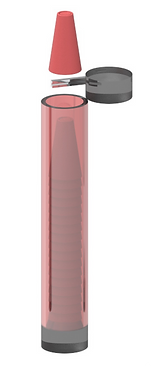
Optional: users can scan the QR code at the bottom of cups to open the tubes and later part of the design (When completing the scan, the QR code shows up on the screen )
the cover can be opened by hand and automatically

To ensure people put the cups in the same direction and take away other items inside, sharp points at the bottom of the tube can tell users put cups upside down.

App design
This app is to strengthen users' motivation for behaviour change. Also, it may make the change last longer. It is mainly about collecting and competing to gain points. After each disposal, users can scan the QR code on the screen to collect visual card collection ( related to environment and colour) in the apps. When finished collections or ranked high, users may gain rewards.
1. Homepage
2. Scan
3. Collection (New )
4. Collection


open the app click the scan button
scan the QR code (under the rainbow)
Collection card is random each time. (gamification: curiostiy) Cards are about different colours of different plants.
All collection cards collected by users will show up here.
6. Reward

After gaining some points, users can get some rewards ( coffee cupon,or charity group will donate to environmental protection) (gamification: achievement)
5. Rank
4. Collection (All)


Users get some points after each disposal. They can compete with other people. (gamification: competition)
There are different categories of collection cards (e.g. green series -- gamification: collect & challenge) when users collect all cards in certain series, they will get extra points
Prototype
Method
1) Bodystorming + low-fidelity (cardboard + plastic bottles)
Bodystorming requires users to experience the design project, which can directly learn about their feedback. Also, designers may observe the process and find out some problems. To strengthen the authenticity of prototyping, it is necessary to create some simple physical models based on the design idea. Design outcomes require colorful and transparent material, plastic bottles can meet the requirement, and the shape is also similar to the outcome. Cardboard can be made in other parts of the models.
2) Low fidelity from paper to digital
Owing to app design being part of the outcome, its function needs to be tested. Using digital prototyping can provide real interaction, while paper prototyping is less authentic.
Feedback
1) The appearance of the design is attractive for its colours and rainbow image. Participants are willing to try on the product. All steps in the process of design are logical and it actually changes the behaviour.
2) Negative: the whole design process is complicated. Participants sometimes got lost during the testing or they just want to complete some parts of the process. Also, they wonder if they can just match the cups with tubes by themselves.


Conclusion
Wilson (2013) pointed out 3 key factors:
1) Function: how well does the design work?
2) Behaviour: Would the user’s behaviour actually change?
3) Consequences: What are the consequences of the change?
1) Function: Part 2 of the design (app) might be neglected by participants. Participants think the app is another design or they just want to simply finish the disposal. Another problem is the importance of using automatic technology to open the tubes.
2) Behaviour: Participants former behaviours are changed. Participants are willing to sort cups by colours, while using the app might not be vital for them.
3) Consequences: They are willing to take away other items from the cups, which can make the disposal more effective. Besides, it can save room in the bin for stacking up the cups together.
Reflection
Unsolved problems
1) The necessity of using automatic technology in the process of opening the tubes. The initial purpose of automatic technology is to ensure users actually match cups and bins with colours. However, it needs to be more steps to ensure this result. There are 3 directions to solve this problem: First, using the original idea, which is that users sort the cups with colours by themselves. Second, find another way to match cups and tubes. This version needs to print the QR code on the cups and the cost is definitely raised. Third, combine technology and users’ subjective initiative just like now.
2) The usage of the app. The original purpose of designing the app is to strengthen the feedback of disposal. In the beginning, users just see the rainbow on the screen after disposal. It may be too simple and not enough for users to continue changing behaviours. The App may motivate them to change their behaviour in the long term or just be neglected by users.
3) Cooperation with the third party: it is important to learn about cup suppliers and café about the different colours of cup supply. Potential reward providers should be investigated.
Wider scale evaluation methods
1)Purpose: investigate the effect of different types of matching cups and tubes.
Location: 3 similar places that are near coffee machines or café on campus
Sample: depends on coffee sales
Duration: one or two weeks
Method: A/B testing + observation + interviews
Set up some middle/ high-fidelity prototypes in 3 similar places on campus at the same time. During the testing, researchers need to observe people about if they use the design or how they use the design. After people finish disposal, researchers have a simple interview with some people about their thoughts or feelings about using or not using the design. Comparing the results of different types of matching cups and tubes can show which solution is better.
Success measure: Firstly, researchers may observe how many people use the design. Secondly, the number of cups collected in tubes can be calculated. Designers may directly know users’ satisfaction through interviews.
2) Purpose: find out whether design outcomes without the app can change behaviors for a long time
Location: one place near coffee machines or café on campus
Sample: depends on coffee sales
Duration: three weeks or more
Method: observation + interview+ SUS
Set up some redesign middle/ high-fidelity prototypes (based on the design with best result in the first unsolved problem) in places on the campus. During the testing, researchers need to observe people about if they use the design or how they use the design. After people finish disposal, researchers have simple interviews with some people about their thinking or feelings about using or not using the design. Also, users need to complete a SUS survey.
Success measure: Firstly, researchers may observe how many people use the design. Secondly, the number of cups collected in tubes can be calculated. Designers may directly know users’ satisfaction through interviews and SUS sore.
3) Purpose: find out whether the app is necessary, its influence on long-term behavior, and its selection of content. Location: offline (same as above) + online
Duration: three weeks or more/ AB Testing (10 people in 1 group, 2 groups)
Method: A/B testing+ interviews + observation + app data Test together with 2).
During the testing, researchers need to observe people about if they use the app. After people finish disposal, researchers have simple interviews with some people about their thoughts or feelings about using or not using the app. Recruit 10 people who use the app and 10 people who do not use the app for further testing. Compare these two groups in the duration of behavior change. Users’ actions on the app can be learned about in the app backstage.
Success measure: First, researchers may observe how many people use the app. Secondly, designers may directly know users’ satisfaction through interviews. Through A/B testing, if people who use the app have a longer time in behavior change, it can show that app design can change behaviors in the long term. app data can show how many users use the app, how long they use it, and which part of the function is vital or less vital.
Ethics
Positive influence
1) Personal: people may enjoy using the design and gain a sense of achievement. It can also be a social platform. In the beginning, the designer just combined a rainbow with the colour of obsessive-compulsive disorder. In addition, people who support LGBTQ+ may actively join owing to the rainbow symbol. Other people may join this campaign unconsciously, which may cause ethical issues. 2) Environment: Effective recycling is beneficial to environmental protection and this is ethical.
Negative influence
1) Personal: people may think the outcome is too complicated so that they do not change behaviours. However, people with colour blindness may think this outcome is not inclusive. Although people do not need to actually identify the colour, these people cannot enjoy it because all parts of the design are based on colours, which may cause ethical issues.
2) Stakeholder: Cup providers and café are required to supply cups with different colours or even QR codes printed. Also, physical reward providers may be café or environmental groups, which is not fully considered. These may be about business.
